For Beautiful, For Spacious... Pages?
Reading:
America: The BookEverybody has already said their piece about this left-leaning (but largely non-partisan) take on Democracy, America, and All Things Political. Tom Carson of the New York Times Sunday Book Review went so far as to suggest that
it should be nominated for a Pulitzer Prize for history (the link only works if you subscribe to TimesSelect, a really annoying new feature of the NYTimes website).
Wal-Mart and
two Mississippi library systems have refused to carry the book for reasons of taste and decency (so they plausibly say). Publisher's Weekly named it
Book of the Year (2004) (I can't link directly to the PW article, since it requires a pay subscription that I don't have). Everybody on earth has offered reviews, it seems.

So I'm going to do something different. Yes, I find the book amusing--at times even insightful, though at times a little too base for my tastes. What I find particularly appealing about
America, though, is not actually its content. Rather, I am taken by the book's
form.
In terms of design, Jon Stewart and the Daily Show team have put together a masterpiece. The lines are simple and elegant. The color scheme is bold. Charts and graphs are straightforward and easy to read (if sometimes ridiculous), and pictoral interludes are cleanly and crisply designed with plenty of negative space to offset the images. Even the font is nice (though as for that, perhaps we oughtn't be surprised: font is often the only internal graphic element over which mainstream books take care).

I confess that I wouldn't buy a book simply for its nice clean lines and its excellent use of space, but I bet
Diana Eng would. And she wouldn't be wrong, either; people buy coffee-table books all the time because of their form and design. I too can imagine buying a book for formal reasons, though I would privilege a different kind of form: for me, heavy pages, leather bindings, real ink, large size, and illumination would make a work worth owning regardless of content. But the idea is the same, and
America: The Book is a beauty after its fashion.
(Note that clicking the page images will blow them up to a larger size for your leisurely perusal.)
Beauty, Goodness, Truth: What Socrates Got Wrong
Read:
Death in Venice. (Also read, as a direct result of having read Mann: Plato's
Phaedrus.)
Death in Venice is a complicated and excellent little book. I'm left a bit confused as to what's going on intellectually, however. On the one hand, Aschenbach moves from being a determined, cerebral, prominent and dignity-filled author to being a debased man ruled by his passions. The sense of duty and level-headedness that had guided his earlier working life disappears swiftly once he sees Tadzio, a youth of extraordinary beauty. Aschenbach abandons his writing, his steadfastness, and his well-considered plans to flee Venice. He leaves behind all dignity, as well: the writer sneaks around the city following Tadzio; he has his hair colored and makeup applied in order to look younger and more desirable to the boy; and he ultimately dies of an easily-avoidable bout of cholera because he could not bring himself to leave the diseased city where Tadzio is staying. In one way, then, this story is about the decline of an old man who, once having let his passions get the better of him even for an instant, is caught inexorably in a downward spiral.
But there are hints, too, that this is not precisely a bad thing (and it is this that leads to my confusion). Clearly, Aschenbach's obsession with Tadzio draws him from the cerebral to the passionate, from diligence to distraction and leisure. One of his best and most admired works comes out of his passion and preoccupation, however. Moreover, Aschenbach himself is filled with joy at even just the sight of Tadzio (to whom he never speaks). Perhaps most tellingly, though, are the constant references to Plato's
Phaedrus, in which Socrates (ironically and seriously, in turns) extols love and lovers. "Beauty," the
Phaedrus tells us, "is the only form of intellectuality which we perceive with, and can tolerate with, our senses. Otherwise, what would become of us if the godhead, if reason and Goodness and Truth were to make themselves directly known to our senses? Would we not perish and burn up from love...? Beauty is therefore the path taken by a man of feeling to achieve the intellectual." Tadzio's extreme beauty, which drives Aschenbach to destruction, is also represented as a kind of Platonic Ideal, then. Moreover, it seems like an appreciation of the boy's beauty
ought to form the perfect bridge between the cerebral and the passionate within Aschenbach himself.
Yet somehow the boy's beauty ends up not as the apotheosis of some divine or near-divine thing (as it ought to in a story that parallels the
Phaedrus, in which Socrates points out that Eros, too, is a god), but rather as something like a "gateway vice." Aschenbach's initial appreciation of Tadzio is intellectual, perhaps even spiritual (or so he tells himself, and it seems plausible to believe it): the great writer notices a perfection of form, and himself reflects upon Plato, Beauty, and the nature of divinity. In fact, we might say that Aschenbach allows himself to fall in love with Tadzio only because his beauty is so easily intellectualized. Having let down his guard and opened the door to passion and feeling even just a little, however, Aschenbach is overwhelmed, and ultimately doomed.
Yet perhaps this makes sense. After all, Aschenbach is not a "man of feeling" whom sensed beauty can move towards the more intellectual. He is an intellectual and reason-driven man already; and his indulgence of passion and worldly feelings, even in the dignified way of his early encounters with Tadzio, can only lead him astray. Aschenbach never perceives a physical, sensible instantiation of Goodness or Truth, but his appreciation of Beauty is sufficient to destroy him. Ironically and pathetically, then, Aschenbach ultimately does "perish and burn up from love."
The Tale of the Unknown Island...
...is a fairy tale written through a haze. The characters are everymen, with a king who would rather recieve favors than petitions, a dreamer who wants a boat to find an island that he doesn't know exists, and a washerwoman who is sucked into his dream. There is a moral: life follows belief (or desire), and not vice versa. The man and washerwoman end up living together on their impossible island (if only in yet another dream), drifting asea in forests and in love. They never
find their unknown island, precisely, but they do
make The Unknown Island out of their boat itself. They float together, perhaps in perpetuity, living their ideal; their hopes, dreams, beliefs, and desires are made real precisely because they indulge them.
All this is well and good, and the style is appropriately fluid and flowing (little punctuation breaks up the dreamy stream of words). But Saramago's little story didn't really do that much for me, even if I recognize a kind of textual richness in it. Perhaps it said a lot, but it evoked very little in me.
Rime (not reason)
For the first time in years, I reread
"The Rime of the Ancient Mariner" last night. It is a brilliant poem. It is, perhaps, the only poem I know which is so obviously a great success as a
story. Certainly, other poets (some quite well-known) are first and foremost storytellers; Robert Browning comes readily to mind on this count. But nobody's poetical stories are quite so gripping as Coleridge's is here.
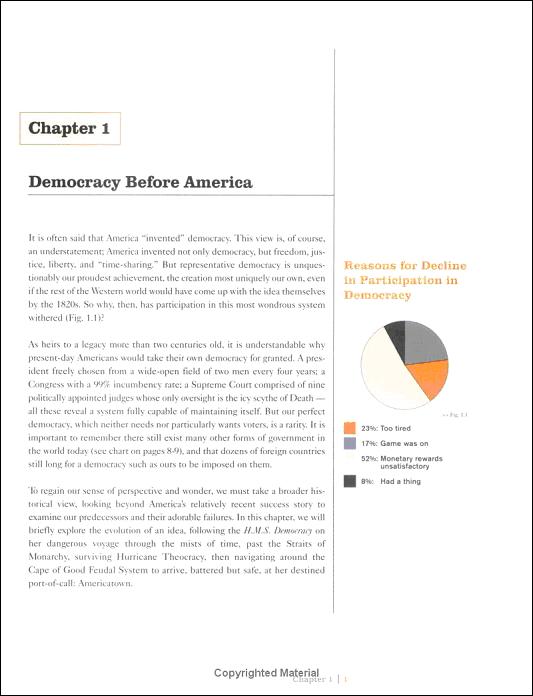 So I'm going to do something different. Yes, I find the book amusing--at times even insightful, though at times a little too base for my tastes. What I find particularly appealing about America, though, is not actually its content. Rather, I am taken by the book's form.
 I confess that I wouldn't buy a book simply for its nice clean lines and its excellent use of space, but I bet Diana Eng would. And she wouldn't be wrong, either; people buy coffee-table books all the time because of their form and design. I too can imagine buying a book for formal reasons, though I would privilege a different kind of form: for me, heavy pages, leather bindings, real ink, large size, and illumination would make a work worth owning regardless of content. But the idea is the same, and America: The Book is a beauty after its fashion.

