Collapse
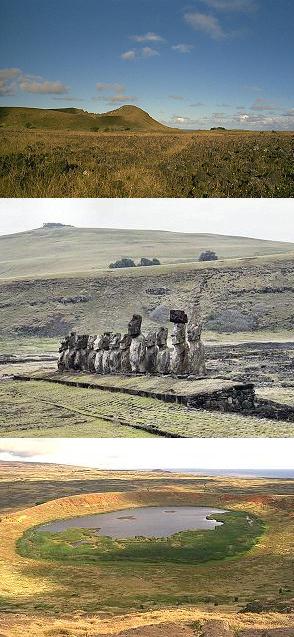 Easter Island has no trees.
This is striking because Easter Island was once a forested, tropical paradise. The island was home to native varieties of the giant palm, the tree daisy, the toromiro, and numerous kinds of shrubs, among other plant and tree species. All are now extinct.
Easter Island has no people. This is striking because the island does have buildings, quarries, trash heaps, tools, and monuments (the famous moai, Easter-island's giant statues), which could only have been left by people. Indeed, high-end estimates suggest that, at its peak, Easter's population may have reached 30,000.
Jared Diamond, Pulitzer-prize winner and author of Collapse: How Societies Choose to Fail or Succeed, suggests that the lack of trees, and the subsequent lack of people on Easter Island, is no coincidence. After all, he says, it wasn't like a natural disaster uprooted all the trees, leaving the population stranded without food, fuel, or the raw materials for boat-making and composting for their fields. No, what happened on Easter Island was this: the Easter Islanders cut down all the trees. Every single one of them.
That's it. In what turned out to be an act of societal suicide, this group of rational-actors, people who had managed roadways and agriculture, a strictly hierarchical society, and complex mining operations, cut down every single tree until they were living on a barren rock. Without the fruits of their trees and without the ability to build fishing boats out of wood, and with increasingly poor soil due to erosion and lack of organic compost, the Easter Islanders had nothing to eat. In desperation, they turned to cannibalism. Then they starved to death.
Jared Diamond doesn't think the Easter Islanders were particularly bad environmental managers. After all, he points out, lots of other Pacific Islanders chopped down trees and raised livestock and set up a complex agrarian society and burned forests to make room for fields. Many of those people are still around today, on Hawaii and elsewhere, practicing those same kinds of farming techniques. The difference is that, based on everything from average rainfall to (the lack of) soil-renewing fallout from the Central Asian dust cloud, Easter Island is one of the places most susceptible to deforestation in the world and certainly in the South Pacific. It wasn't that the Easter Islanders were unusually thickheaded or stupid, then, or that they were particularly unlucky in the lifestyle decisions that they made. Rather, according to Diamond, it was Easter Island which was unusual and particularly fragile environmentally. The Easter Islanders just had the misfortune of living there.
But let us consider the story of the Greenland Norse. Unlike the Easter Islanders, perhaps, these were people we could really understand: they raised sheep, goats, and cattle; they had churches and a grand cathedral with stained glass windows and an eighty-foot-tall bell tower (as well as bronze candlesticks, Communion wine, linen, silk, jewelry, and even a bishop from the mainland); they regularly tithed ten percent to the Roman Catholic Church; they grew hay in the summer and built state-of-the-art barns to keep their cattle warm in the winter; they had pets. They had well-developed civil procedures, too: two people wanting to marry had to read the banns out for three consecutive Sundays beforehand (lest there be objections), for example, and there was a required number of witnesses at marriage ceremonies. If someone treated you unfairly, stole your goods, or threw around their power just a bit too much, one could always take a civil suit to the Greenland Assembly.
In one way, though, the Greenland Norse are like the Easter Islanders, and that is that there aren't any of them left. They chopped down their forests for fuel, they dug up their turf to build well-insulated homes (often with six-foot thick turf walls, meaning that a typical home destroyed about ten acres of grassland), they grazed their sheep and cattle on the grass that was left, and, ultimately, they starved to death. In one particularly harsh winter, the Norse at Gardar ate every single one of their remaining cattle down to only the toe bones. They ate the calves (ensuring in the process that they would be unable to regrow the herd in the spring). In the end, they ate their dogs. When they had nothing left to eat, they died.
We might be tempted to chalk the disappearance of the Greenland Norse up to one very harsh winter and to leave it at that, much like the way we chalked up the disappearance of the Easter Islanders almost exclusively to environmental factors beyond their control. To be sure, the Norse could not have known that they would be entering the Little Ice Age any more than the Islanders, on arrival at Easter, could have known that it would take burned or chopped trees twice as long to regrow on their Island as it would on neighboring Islands. But Diamond is at great pains to prove that he is not an environmental determinist (as the subtitle of his book should serve to show us), and the situation of the Greenland Norse is far more complicated than that of the isolated Easter Islanders. After all, at the same time that they lived in Greenland, that island was home to many Inuit people--and the Inuit survived the harsh winters and still survive today. What was it, Jared Diamond wants to know, that caused the well-formed Norse society to collapse so quickly that valuable wooden objects remain strewn about on the floors of their ruined houses, while their Inuit neighbors continue to thrive centuries later?
What it is, we discover quickly, is that the Norse were too attached to Europe to be attached to Greenland in a reasonable (some would say "sane") way. They spent their summers hunting Walruses, valued on the mainland for their ivory, and traded these for luxury items and theological needs that reaffirmed their European culture; Diamond points out that they might otherwise have spent these summers trading for wood on Labrador, like the Inuit, thereby alleviating the environmental pressures on their part of Greenland. The Norse valued cattle, too, just like their ancestors in Norway, and rich chiefs spent great time and effort raising their cattle and growing hay to sustain the herds through the winter. For some reason, they had a taboo against eating fish: one researcher sifted through 35,000 bones from the garbage of a Norse farm and found only two fish bones (and other researchers have had similar results). The Christian Norse looked on the "pagan" Inuit with scorn and considered their own ways to be far superior.
And the Norse were right; many of their ways were far superior. The Norse had iron tools, a more diverse potential food supply than the Inuit, and ready European trading partners. But the Norse came to Greenland with a strong sense of culture that kept them from adopting many of the more rational ways of the Inuit, too; the Norse never learned to hunt the ringed seal, plentiful in wintertime (when the hayless cattle were starving), they never learned to build igloos, preferring instead European-style wooden houses even in a land where ice was plentiful and wood was not, and they never hunted whales. In a land where one can pluck fish bare-handed from riverbeds, they chose never to eat fish. Summers that could have been spent preparing for the winter were indeed spent haying--but also looking for European luxury items and gathering necessary tithes, and trading their goods away for stained glass and silver chalices. Winters were spent using up their stores even as seals and fish were out in abundance. In the end, the Greenland Norse starved to death in a land of plenty.
This is a sad story, but also a baffling one as we look back on it from the perspective of hindsight. Why on earth wouldn't the Norse fish? Why would they spend so much time and effort hunting walruses, but never think about hunting the ringed seals that were so plentiful in winter? Why would they privilege beef, the least hardy of their animals and the least land-efficient as well, over their much hardier and efficient goats?
Diamond distinguishes between cultural and biological survival, and he is right to do so. The Norse didn't just want to continue to exist as people; rather, they wanted to continue to exist as Norse. Rich Norsemen keep cattle. They pay tithes. They keep wooden crucifixes in their houses and make sure they announce the banns for three consecutive Sundays before marrying, in a church, in front of the right number of witnesses. They are not pagans, and they don't hunt seals or live in iceboxes or do any of those backwards pagan things. These considerations are important, Diamond rightly points out. The Greenland Norse were not trying to commit biological suicide, but were rather trying--desperately--for cultural continuation and for differentiation from the Inuit.
In this, to the end, they succeeded. In one harsh winter, the Greenland Norse all starved to death--but they never did eat fish, and they never did take down the roofbeams from their churches in order to carve out hunting boats. That would be un-Christian. It might be Inuit. It would, at any rate, be un-Norse.
After all, without one's values, without one's cultural inheritance, what is there left to die for?
posted by Skay @ 5:34 PM

